

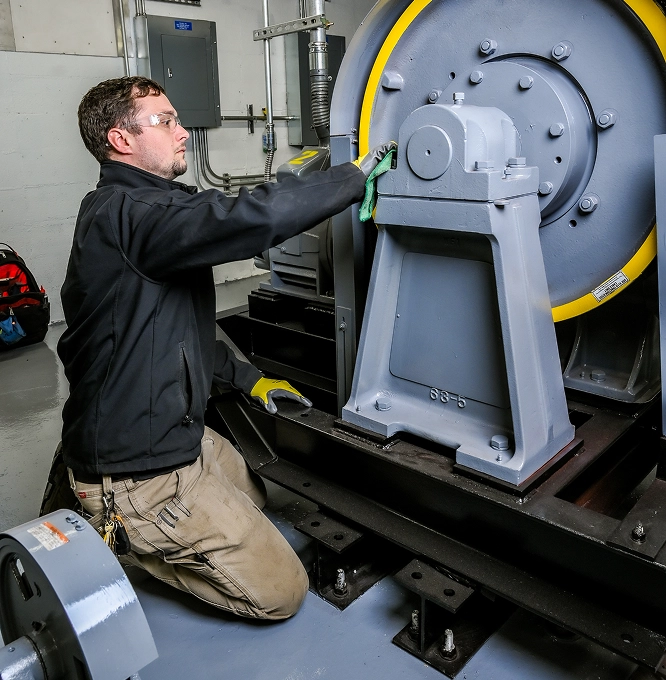


Gearless Elevator Repair in North & South Carolina
How We Diagnose Gearless Elevator Faults
The service call begins with the failure pattern. We review fault history, recent callbacks, ride behavior, door operation, leveling accuracy, and any changes building staff have noticed before testing the components tied to those symptoms.
Once the fault is confirmed, we walk through the scope of the repair and what it will cost, and nothing proceeds until you approve it. If the equipment condition suggests that repeated repairs are becoming less effective, we can also discuss elevator modernization rather than continuing to replace aging components one at a time.
Commercial Gearless Elevator Repair Services
Gearless systems combine mechanical components with sophisticated electrical and electronic controls. Our repair work follows the fault across those systems instead of treating the machine, controller, and doors as unrelated equipment.
Diagnose faults involving variable-frequency drives, control boards, relays, wiring, and other components responsible for normal travel.
Address inaccurate or lost feedback that can affect speed, leveling, stopping, and fault detection.
Correct brake conditions that affect stopping, holding, ride quality, or safe operation.
Evaluate abnormal noise, vibration, overheating, or performance changes involving the gearless hoist machine.
Find out why the car lands high or low at a floor, whether the cause is feedback, drive, or brake related.
Fix worn locks, failing operators, misaligned sensors, and damaged rollers that keep the car from dispatching or force it out of service.
Evaluate traction components when wear, tension, or related operating issues affect performance.
Trace vibration, hesitation, abrupt starts, or rough stopping back to the responsible mechanical or control system.
Diagnose wiring, power, control, and communication problems affecting elevator operation.
Respond when a gearless elevator shuts down and cannot wait for a scheduled visit.
Leveling and Ride Quality Can Point to a Feedback Problem
Accurate leveling depends on the controller knowing where the car is and how fast it is moving. Encoder faults, drive issues, brake response, or control problems can all cause the car to stop inconsistently or produce rough starts and stops.
Repeated leveling adjustments without identifying the underlying cause can leave the same fault in place. We look at the feedback and control sequence as a whole before narrowing the repair.
Brake Problems Need More Than a Visual Check
The brake on a gearless traction machine plays a direct role in holding and stopping the car. Wear, adjustment issues, electrical problems, or improper operation can create noise, rough stopping, fault conditions, or shutdowns.
Because brake performance interacts with the drive and controller, diagnosis should include both the mechanical condition and the commands controlling it. That helps separate a brake hardware problem from a control issue producing similar symptoms.
Door Faults Can Stop a Gearless Elevator That Is Otherwise Healthy
A gearless machine may be operating normally while a worn door lock, failing operator, misaligned sensor, or damaged roller keeps the car out of service. Door systems remain one of the most common sources of elevator callbacks regardless of machine type.
Regular elevator maintenance means technicians see door, brake, and control changes earlier, and a small adjustment is easier to schedule than a shutdown. Charter’s maintenance plans are tailored around equipment type, building use, service history, and operating demands.
Is It Time to Modernize Your Gearless Elevator?
A single bad encoder, drive, board, or door part is not a reason to modernize. If the parts can still be sourced and the remaining equipment holds up, repair is usually the practical call.
Modernization becomes worth evaluating when controls are obsolete, proprietary components are difficult to source, shutdowns become frequent, repair costs continue rising, or performance problems return after repeated corrective work. In those cases, commercial elevator modernization can address several aging systems together.
Gearless Elevator Repair FAQs
Why is my gearless elevator stopping unevenly at the floor?
Misleveling can involve encoder feedback, drive performance, brake operation, controller inputs, or another position-related fault. Testing the feedback loop comes before replacing any part.
What causes a gearless elevator to jerk or hesitate?
Rough starts or stops can develop from drive settings, encoder problems, brake behavior, control faults, traction issues, or other components affecting acceleration and deceleration.
Can Charter repair gearless elevator drive faults?
Yes. We diagnose drive, controller, feedback, and related electrical faults and develop a repair scope based on the specific equipment and confirmed failure.
Do gearless elevators still need regular maintenance?
Yes. Gearless equipment still relies on doors, brakes, controls, traction components, electrical systems, and safety devices that require routine inspection, adjustment, cleaning, and service. Not sure what type of elevator you have? We also repair hydraulic elevators.
When should a gearless elevator be modernized?
Modernization becomes more practical when frequent faults, obsolete controls, unavailable parts, unreliable ride quality, or repeated shutdowns make continued repair less effective.
Maintenance Helps Prevent Repeat Control and Door Faults
Gearless elevators benefit from maintenance that follows operating history instead of a generic checklist. Door adjustments, brake checks, control observations, cleaning, and attention to recurring faults can reveal changes before they become larger service calls.
Charter builds maintenance around each building and its equipment, so it reflects how the elevator is actually used. The service history from those visits gives our repair team a reference point when a fault comes back.
Rapid Repair Support Across Commercial Properties
A gearless elevator shutdown can affect tenant access, deliveries, building traffic, and accessibility throughout the property. Charter Elevator provides rapid repair response and 24/7 emergency service for commercial and multifamily buildings across the Carolinas.
Since 2015, our team has completed more than 1,000 elevator projects involving maintenance, repair, modernization, and related service. That experience helps us evaluate both the immediate gearless fault and the longer-term condition of the elevator.
Where We Repair Gearless Elevators in NC and SC
Gearless elevator repair is available to commercial buildings in Charlotte and Wilmington, North Carolina, as well as Columbia and Charleston, South Carolina. Owners and managers in Raleigh and Myrtle Beach can reach the same repair team, and our service area page shows the locations we cover.
Gearless elevator systems vary by manufacturer, controller generation, drive technology, building use, and maintenance history. Our repair process starts with the installed equipment rather than assuming the same fault belongs on every traction elevator.
Call (877) 632-4278 or contact us online if your gearless elevator is down or acting up.